
Surveying Terry Gilliam’s career as a film director is an exercise in frustration and disappointed. Although he possesses a truly original visual imagination and a wonderfully savage sense of humor, his filmography is littered with movies that are dismally mediocre or just downright terrible. (I recently rewatched Jabberwocky, wondering if it was as bad as I remembered it, and it proved to be much, much worse.) Too often, his astounding visuals seem strung together with no real plot (such as The Adventures of Baron Munchausen and The Imaginarium of Doctor Parnassus), and his glee at looking at the ugliness of human life results in a film that, when watching it, the viewer feels like they’re being buried in an avalanche of grossness (see Fear and Loathing in Las Vegas or the aforementioned Jabberwocky). Even some of his more successful films, like Time Bandits and Twelve Monkeys, give the impression of having better movies hidden inside that didn’t get a chance to come out.
But among Gilliam’s works there stand three that are undeniably great. The first, Monty Python and the Holy Grail, co-directed with Terry Jones, is more a product of the collective Python genius than an expression of Gilliam’s own vision. (When Gilliam 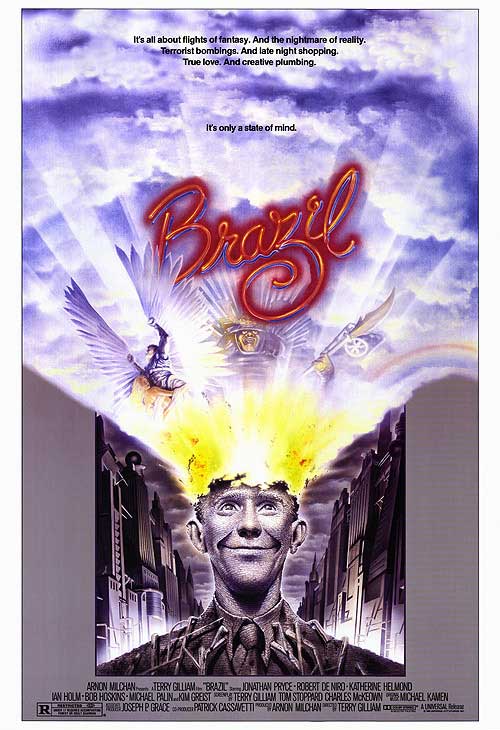 followed up with another film based on the idea that the Middle Ages was a dirty, shitty, and bloody time, he gave us the disastrous Jabberwocky.) The second great work is the delightful and inventive “The Crimson Personal Assurance,” the short subject that preceded Monty Python’s The Meaning of Life and was arguably better than anything in the latter, with its hilarious blend of corporate satire and piratical derring-do.
Gilliam’s third great work, and his absolute masterpiece, is Brazil.
In Brazil, everything clicks. The stunning visuals are wedded to a well-crafted story. The pessimistic view of human nature is leavened by humor that is actually funny, and characters that are more than just caricatures. It is one of the greatest movies ever made.
I was twenty when I first saw it. As I recall, I went to see it in the theater three times — I just couldn’t get enough of it. It seemed to me to be the perfect movie. Certainly, it pushed all of my buttons. The political satire, the dark humor, the surreal fantasy sequences, the gleeful absurdism — it was a combination of all the things I most liked in my art, combined together in a way that shouldn’t have worked at all, but did.
Brazil is set “somewhere in the 20th Century” in an unnamed country that has elements of both British and American culture. (But not Brazilian: The title refers to the classic song, not the country.) The characters all speak with their actors’ accents, so we have oddities such as protagonist Sam Lowry (Jonathan Pryce) speaking with a crisp BBC accent, while his mother (Katherine Helmond) talks like an American. Though ostensibly set in the “future,” the aesthetic is more mid-20th Century. It’s how people in 1948 might have thought the future would look like.
In this dystopia, the oppressive government oversees all aspects of people’s lives, similar to that in Nineteen Eighty-Four. However, unlike the ruthlessly efficient ministries of Orwell’s work, the regime in Brazil is a tangled web of bureaucratic red tape and sheer incompetence. If anything, this makes them even more terrifying. In Nineteen Eighty-Four, Big Brother will track you down and torture you if you commit thoughtcrime. In Brazil, the government will track you down and torture you if someone with a name similar to yours committed thoughtcrime, and a random typo gets your name mixed up with theirs.
Our protagonist, Sam Lowry, is a Walter Mitty-ish figure who is part of the bureaucracy but fancies himself a hero, losing himself in fantastical dreams in which he is a valiant warrior attempted to save a fair damsel from a giant metallic Samurai monster. When he meets a young woman named Jill (Kim Griest) who looks exactly like his imagined heroine, he becomes obsessed with her, and uses his resources to track her down and “rescue” her — but his efforts end up dooming them both.
The movie would be depressing to watch if it weren’t also absolutely hilarious. (All of which goes to show that comedies can get away with being a lot bleaker than tragedies.) The movie is filled with absurdities: a government official chastising terrorists for “poor sportsmanship”; Sam’s mother getting plastic surgery that literally turns her face elastic; Sam stuck in a tiny office with half a desk, which he wrestles to keep from being dragged into the office next door; a fancy restaurant displaying elegant dishes but serving bland piles of mush on plates; an apologetic guard knocking Sam to the floor (“Sorry, sir. Regulations.”), and on and on.
It helps that Gilliam was able to assemble a dream cast. Aside from Pryce and Helmond, the actors include Robert De Niro, Ian Holm, Michael Palin (in possibly the best role of his career as the most affable torturer imaginable), Bob Hoskins, Jim Broadbent, and many a British character actor that you will recognize by sight, if not name.
I said above that when I was twenty I considered Brazil to be the perfect movie. Looking at it today, I can see that it has one flaw, that being the character of Jill. It’s true that Gilliam was apparently unhappy with the performance of Griest, who was not his first pick for the role. (Allegedly, he considered having Madonna play the role, which would have been an… interesting choice.) But to be fair, it may not be Griest’s fault. The character is thinly written. Gilliam intended to set up a contrast between the fantasy figure that Sam sees in his dreams, and the actual human being that he meets in reality. But Jill is still a fantasy figure: he destroys her life, but she is apparently just fine with sleeping with him. (A female friend of mine with whom I saw the movie once could not get past that.)
Nonetheless, the film remains as the peak of Terry Gilliam’s film career. What made this one work so well, compared to his other movies? Perhaps it was the fact that Gilliam had a concept that played to all of his strengths as a director, and none of his weaknesses. Perhaps it was the inclusion of Tom Stoppard (whose genius with words and plots was equal to Gilliam’s genius with images) among the screenwriters (who also included Charles McKeown and Gilliam himself). Perhaps it was one of those results of a simple confluence of events that cause everything to come out right, and for that we can be thankful.